Stop Second Guessing | Neurographic Art Speeds Decision-Making

Stop Second Guessing yourself. Neurographic Art Speeds Decision-Making Gently rewire your brain using curvy lines, shapes and color. Sounds silly, I know. I too was a skeptic.
What is Neurographic Art?
Neurographic Art is a quick, visual thinking process that helps you calm
your mind and make faster, clearer decisions.
Are you stuck replaying the same choices all day, losing focus, and losing money while you stall? This is what I used to do. You are in good company. When a decision sits on your mind, the same thoughts loop and loop, and your stress climbs. Here is a simple fix you can try with a pen and paper.
I did a deep dive into the subject of decision making and here is what I came up with…
McKinsey shows 57% of executives believe their organizations make bad decisions as often as good ones, 98% of managers fail to apply best practices in decision making, and 80% of new products fail due to poor decisions.
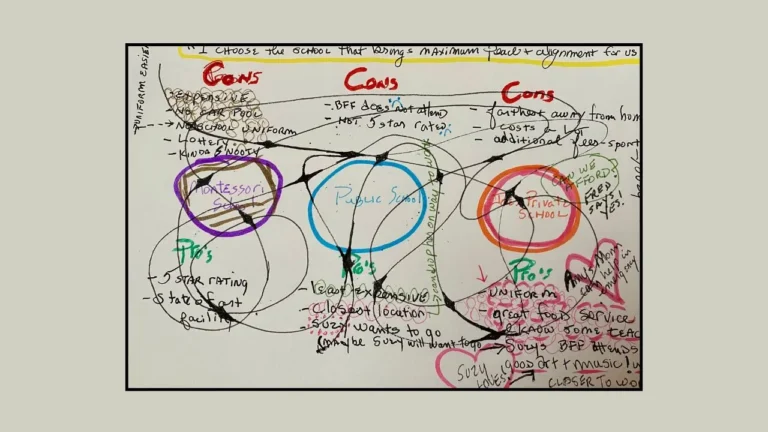
Use Neurographic Art to interrupt rumination so you can make faster decisions with less stress. In plain terms, Neurographic Art is a visual thinking process that helps you repattern thought loops using lines, curves, shapes, and color.
This psychological technique is credited to Pavel Piskarev, an author who introduced the approach in 2014 based on psychological principles, and it pairs beautifully with a short writing prompt to get clarity fast.
If you create content, run a business, or juggle projects, this tool helps you break blocks, choose a path with confidence.
It is a self-help process, distinct from formal art therapy, so still use good judgment for high-stakes or legal choices. Or hire a professional.
In this guide you will learn what Neurographic Art is, why it speeds up decision-making, and a step-by-step routine you can do in 10 to 15 minutes.
What Is Neurographic Art and Why It Speeds Up Decision-Making
Neurographic Art is a guided drawing process and it can speed up your decision making process.
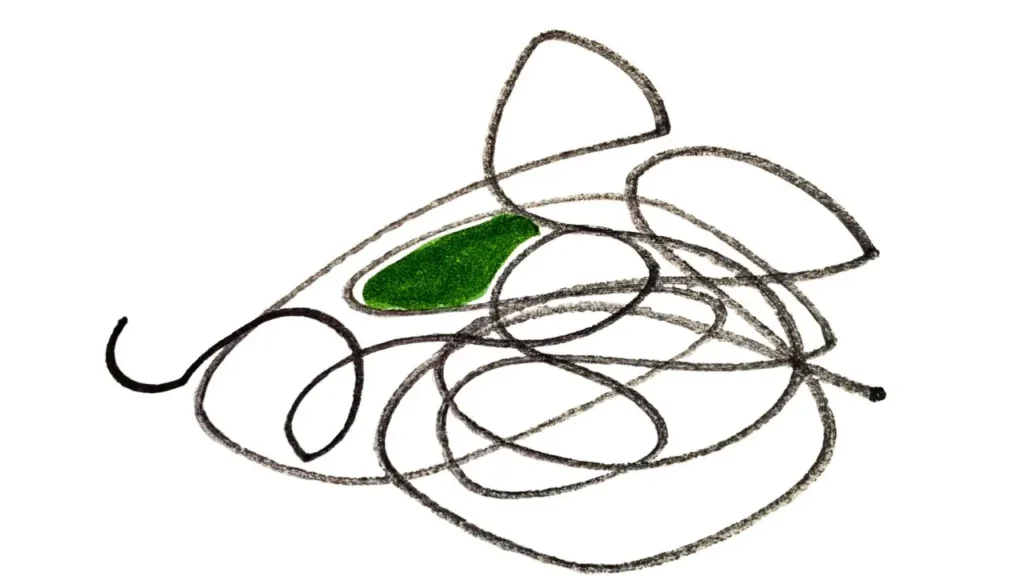
I start with an intention, by drawing intuitive or random, free-form lines that intersect. Then I round sharp corners and add shapes and color.
These intuitive lines offload your mental chatter onto the page. That little shift calms your nervous system, provides stress relief, and makes your options easier to see.
Here’s why it works. Visual tasks create new neural connections, so your brain stops following the same loop. Pattern breaks interrupt recurring thoughts. The act of drawing, especially when you round corners, signals safety and reduces tension.
As your state changes, the shift calms your nervous system and can induce a meditative state. Clarity rises, and your next step becomes obvious. You move from endless thinking to seeing your choice on paper.
If you are a founder, freelancer, or creator, you make constant choices about offers, pricing, scripts, thumbnails, and timelines.
Fear and perfectionism often slow you down. This method gives you a safe container to explore options with low pressure, so you can choose and move on.
- Faster decisions
- Less second-guessing
- Reduced creative blocks
- Better productivity under deadlines
“Neurographic Art is For self-help use only and is not a substitute for professional therapy.”
How Neurographic Art Speeds Decision-Making

Find Your Focus Type
Pick the focus type that fits your current mental mess — no judgment. Just awareness. Are you the:
- Overthinker
- Multitasker
- Reactor
- Perfectionist
- Scroller
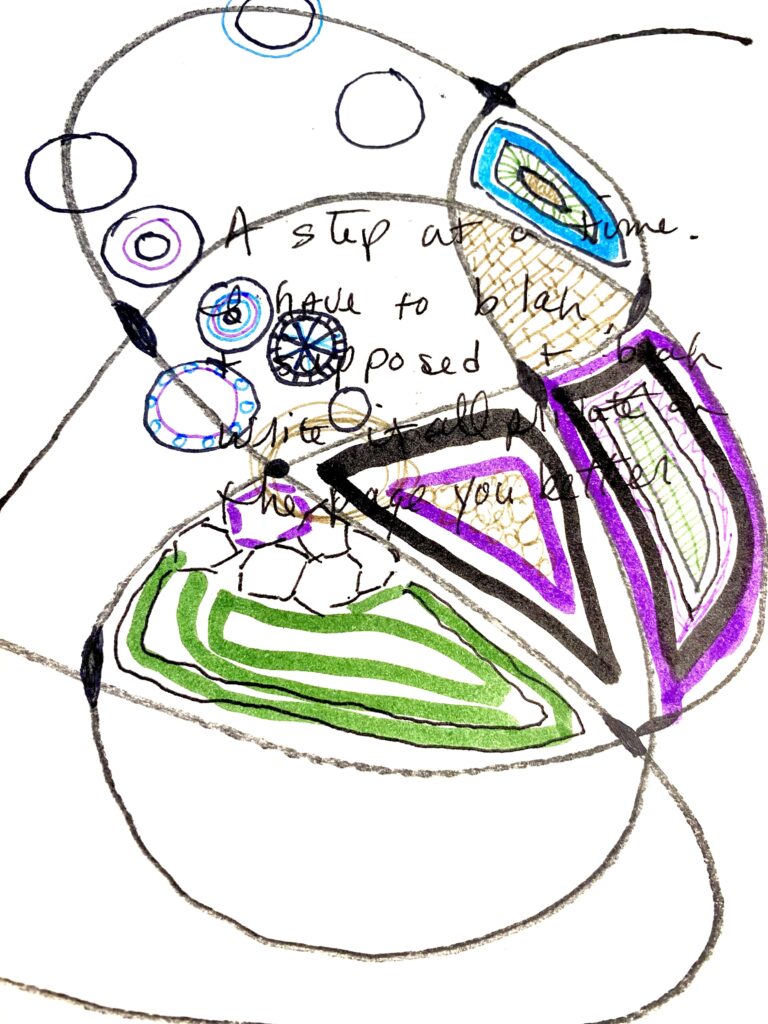
When you loop on a decision, your mind replays the same thoughts. That loop keeps stress high and makes focus hard. This free-flowing method of drawing non-repeating, intersecting lines gives your brain a new path to follow.
As you round each corner, those sharp intersections soften. Your eyes and body read those curves as safety.
You will notice your breath slows, and your mind opens to options. The page becomes a dashboard for your choice, which helps you stop spinning and start deciding.
You may also notice your shoulders dropping to a relaxed position and your tight jaw loosen. I notice all this things. This is why I incorporate neurographic art into my morning routine.
My Neurographic art practice is a gift that keeps on giving throughout my hectic days.
Why entrepreneurs and creators get the biggest lift
Common stalls show up every day. You might be choosing a niche, setting a price, picking a title or thumbnail, saying yes or no to a partnership, or shipping a draft that you keep tweaking.
Neurographic Art lowers the stakes, exposes hidden assumptions, and reveals one small next step you can take today. Better decisions create steadier publishing, cleaner calendars, and more revenue opportunities.

A Simple Neurographic Art Routine Speeds Decision-Making
I do a morning practice and most days I spend 10 to 15 minutes with a pen and a page due to time constrains. Drawing all day would certainly be my preference, but I have to work for a living!
I very often go back to the same page the next day and add a new intention and continue drawing.
No perfectionism, no artistic skill required, no fancy tools needed. Time each step so you do not overthink. If you feel stuck, stand up or switch seats, then continue.
Mini example you can try today: “Pick a launch date for my new offer in the next 60 minutes.”
Step 1: Set your intention in one sentence
Write a short sentence at the top of the page: “Help me make a fast decision about [specific choice].” Add a time box like “Decide by 3 pm today.” Make it specific to the decision you want to make.
Examples:
- Price my new service for Q4.
- Choose my YouTube topic for Friday.
- Pick the call-to-action for my landing page.
- Hire a video editor now or wait one month.
State it clearly so your brain knows the target.
Step 2: Draw intuitive lines that intersect
Take a thick marker. While gently holding your pen let it guide your hand and arm to let the line wander across the page without lifting the pen. Draw lines that cross many times to create intersections.
Keep it loose, messy, and quick. Say out loud, “No perfection.” These lines represent your thoughts without judgment.
The goal is not a pretty picture. The goal is to move your looping thoughts out of your head and into a shape you can work with.
This is a lesson in humility for me because i am a career artist. Making icky art hurts my eyes. If I can focus on the message and not the aesthetics so can you!
Step 3: Round the corners to release tension
At each intersection, soften the sharp angles into rounded curves. This is the core Neurographic technique, with rounding corners at its heart. As you round, notice any shift in this mindful moment.
What you are doing here is breaking patterns. Loop thinking / continual recurring thoughts and worry can be a habit. We want to break this habit.
Edges look calmer, your breath steadies, and you feel a little more room to think. I can’t make the least bit of sense if I am wired and stuck in a loop.
If a spot feels tight on the page or in your body, spend more time rounding that area. You are smoothing the tension and bringing your system back to a calmer baseline.
Step 4: Add shapes and color to surface options
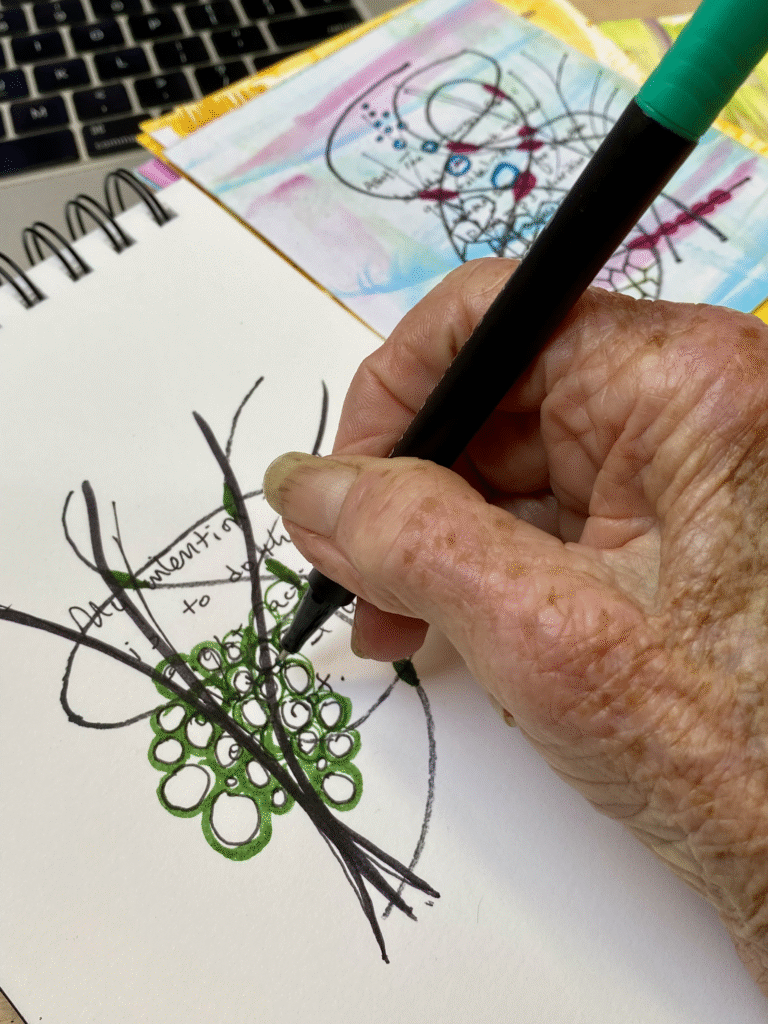
Add circles or organic shapes around areas that feel important. Assign a color to each option or path. As you color, your page becomes an abstract artwork. Jot one or two short notes in the margins. Ask simple questions:
- What matters most right now?
- What is reversible?
- What is the smallest test I can run this week?
You are not searching for a perfect answer. You are surfacing a workable next step that moves you forward today.
Step 5: Close with a 2-step action plan and a time box
Write two moves you will take today, even if the final choice is not perfect. Add a time box for each step. Optional, add a small checkbox next to each item and check it when you finish.
Example:
- Email three past clients with the new offer and price by 2 pm.
- Schedule the launch live for next Tuesday by 4 pm.
Once you take the first step, momentum will carry you. Action quiets doubt. Never wait for motivation to come before you take action.
Faster Decision-Making Protects Productivity at Work
You can apply this routine anywhere you need clarity. Use it to plan content calendars, manage student work, confirm product decisions, or reset client boundaries.
The business impact is simple. Fewer stalls, clearer priorities, steadier output, and stress relief. That equals more shipped work, less wasted time, which should translate to more money.
Do you have personal decisions to make? Try using neurographic art to at least narrow down your choices. While you are in a more relaxed state you will see tough decisions with more clarity.
Turn big choices into small sprints
Large decisions feel scary because they hide many smaller choices. Break them into tiny tests. For a content launch, pick the topic, format, and date. Run a 48-hour test with a teaser post or short email.
Use a fresh page for each small step. That keeps momentum high and fear low. You learn fast, and you can adjust with less stress.
Quick variations for meetings and sticky decisions

Use a 5-minute micro-doodle before a high-stakes call. If you work with a team, try a shared whiteboard version. Start in silence while everyone does Step 1 to Step 3, then compare notes.
For conflicts or tough choices, assign two colors for two viewpoints. Round the overlaps, then find one shared next step. This creates a calm way to see where you agree and where you need more proof.
Track results with a decision log and simple metrics
Create a simple Decision Log. Include date, decision, time to decide, and a quick outcome check in 14 to 30 days. Track three metrics:
- Time to first action
- Publish cadence
- Revenue or leads tied to the decision
Review weekly. Celebrate small wins to build a bias to action. Treat this routine like an algorithm for consistent decision-making. Over time you will see your average time to decide drop, and your output rise.
Common mistakes to avoid
- Overthinking the drawing: Keep it loose and quick. The page is a tool, not a masterpiece.
- Skipping the rounding step: Rounding corners is what calms the system and helps release emotions, especially tension or fear. Do not skip it.
- Hunting for the perfect answer: Aim for a good next step you can test today. Progress is better than perfection!
- Forgetting the 2-step action plan: Without action, insights fade. Write two steps, time-box them, and do them.
Small, consistent sessions beat rare, long ones. Treat this like brushing your teeth for decision hygiene. Your nervous system will thank you!
Tools, Templates, and Prompts to Get Started Fast
Keep your setup low-cost and portable. You should be able to do this at your desk, in a café, or between meetings. You likely have the tools already!
Your basic toolkit under $20
- A sketch pad, printer paper, or the back of an envelope will do!
- One thick black marker, like a Sharpie
- Two to four colored pens or pencils
- A timer on your phone
- Optional: sticky notes for action steps
While simple materials are preferred, you can expand your coloring supplies to explore simple watercolor techniques for added effect. Digital tablets work too if that helps you stay consistent. I love the feel of pens in my hand. I have tried using the Procreate app to draw and for neurographic art this is my least favorite way. I would love to hear from you (or see your finished practice!) if you like using Procreate for art journaling.
Prompts for entrepreneurs and creators
Pick one per session:
- Pick my offer price for this quarter
- Choose my video topic for Friday
- Approve this thumbnail
- Say yes or no to a partnership
- Choose a niche focus for 30 days
- Hire or contract this role now or wait
Write the prompt at the top of the page. Time box the decision. Do the five steps. Take two actions.
10-minute emergency reset before a deadline
Use this when your brain is fried and the clock is ticking.
- 1 minute: Write your intention
- 3 minutes: Draw intuitive Lines that intersect
- 3 minutes: Round the corners
- 2 minutes: Add color and one or two margin notes
- 1 minute: Write your 2-step plan
Breathe out slowly while rounding.
When Not to Use Neurographic Art for Decision-Making?
Alway seek medical professionals if you are struggling with several different medical treatment options. I would caution against asking friends for answers. We are all biased from our own experiences.
I have always been a stickler for hiring an accountant and a lawyer when the need arises. I dislike spending money (when Google can offer free advice!) for these services, but I am not qualified in either of these areas.
And forgive me for saying AI and Google can and often do makes mistakes.
Why I Use Neurographic Art For a Daily Practice
I was introduced to neurographic art a while ago and immediately knew it was a perfect compliment with my art journaling. I am in the habit of writing long hand most days and I just knew this would enhance my practice.
Especially since Covid. I never really got out of Covid mode which was very easy for me. I have worked from home for a very long time so there is that.
I am not a real social person, meaning I am fortunate to have a perfect amount of wonderful friends and tons of acquaintances. Also feeling lonesome is something I, thankfully, don’t experience.
But- and there is usually a ‘but’, through my neurographic art practice I realized I was isolating more than is healthy and I made this change and have to say I am so very glad I did.
My balance is better now.
Try a 7-day streak, one page a day, and track your time to decide. Share one win with a peer or your team to lock in the habit. Pick one decision right now, set a 10-minute timer, draw your lines, and choose your next step today.
FAQ
Marj Bates “I’ve spent nearly 40 years in addiction recovery, decades with The Artist’s Way, and teach The Artist’s Way Reimagined™, a slower, more supported way to work through Julia Cameron’s book The Artist’s Way – blending creative recovery tools, neurographic art, and community to help people move through resistance and stay with the process.
I’ve also changed careers later in life than most people would dare — proof that it’s never too late to begin again.”
MindSketch Lab